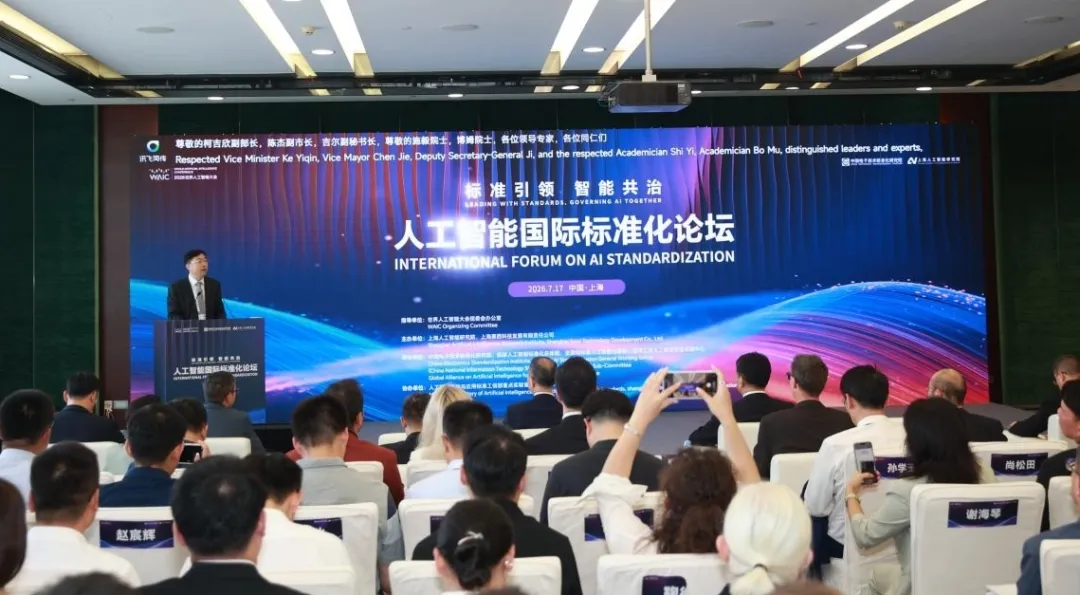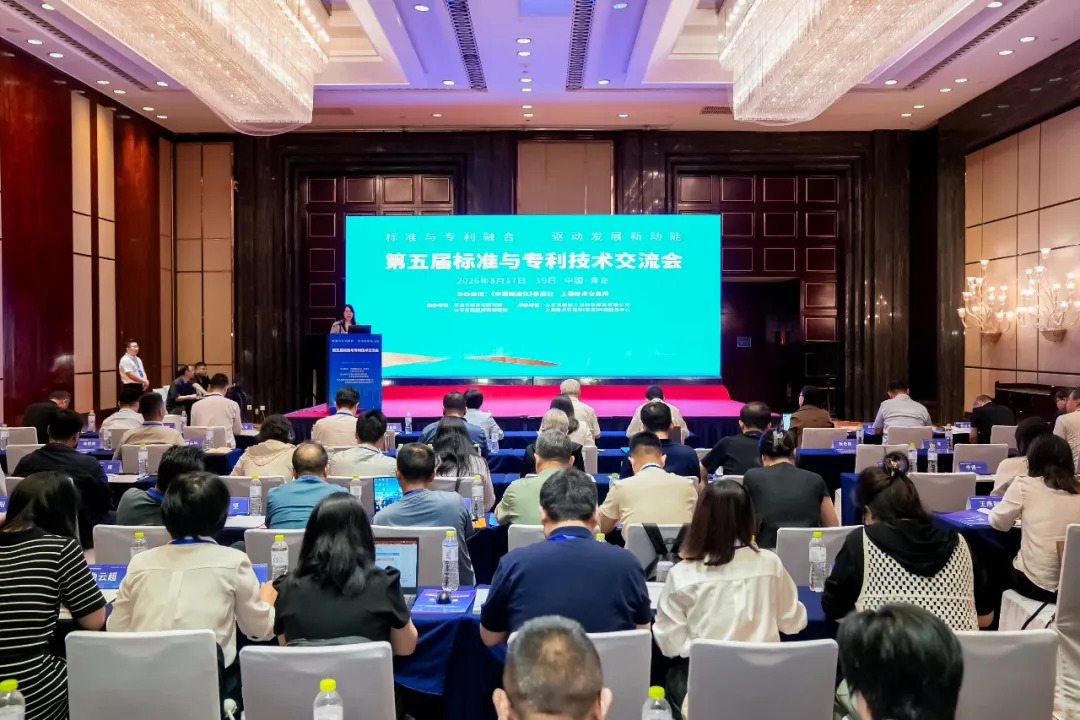
On 8 April 2026, the China Electronics Standardization Institute (CESI) convened a symposium in Beijing on international standardization for artificial intelligence. The meeting brought together over 30 standardization high-level leaders and experts from Huawei, Alibaba, Xiaomi, iFlytek, SenseTime, Hisense, ZTE, Ant Group and Sangfor, as well as research institutions including the China Academy of Information and Communications Technology (CAICT) and CESI itself. Officials from the Ministry of Industry and Information Technology (MIIT), the State Administration for Market Regulation (SAMR) and the Ministry of Commerce also attended.
The symposium addressed a pressing challenge. Chinese AI companies expanding overseas face gaps in international standards alignment, weak rule adaptation capabilities, and poor coordination between industrial application and technical standards. CESI presented China’s overall strategy for global AI governance and standards development. Huawei reported on progress in ISO/IEC JTC 1/SC 42, the key international committee for AI standardization. CAICT shared updates on ITU’s AI standardization work, while Alibaba discussed IETF developments in agent interoperability and security. The meeting concluded that standards have become a critical factor for market access, technical mutual recognition, and compliance in overseas markets.
While SAC/SC42 and Chinese companies are refining their international engagement strategy, another significant development drew attention. GB/T 46347-2025 Artificial Intelligence — Risk Management Capability Assessment, published by the National Standardization Administration of China (SAC) on 5 October 2025, establishes China’s first national framework for evaluating organizational AI risk management maturity.
It defines 6 capability domains — risk management planning, risk communication, risk assessment, risk treatment, risk monitoring, and risk review — and grades organizations from Initial Level to Optimization Level based on a quantitative scoring system. The framework explicitly integrates ethical risk governance into organizational risk management processes, treating algorithmic discrimination, data bias, privacy infringement, deepfake misuse, and information cocoons as core safety risk sources.
This standard draws upon three foundational sources:
- GB/T 24353-2022 Risk Management — Guidelines, an identical adoption of ISO 31000:2018;
- The AI Safety Governance Frameworkdeveloped by SAC/TC260, China’s cybersecurity standardisation technical committee;
- ISO/IEC 23894:2023 Information Technology — Artificial Intelligence — Guidance on Risk Management, adopted by Europe as EN ISO/IEC 23894 in 2024.
The alignment with ISO/IEC 23894 carries particular significance for European stakeholders as CEN-CENELEC JTC 21 similarly draws upon this international standard as a foundational document. This shared methodological base enables organizations to build unified risk management processes capable of serving both Chinese capability assessment requirements and European product-level compliance obligations under the AI Act. European companies that have implemented AI Act compliance programmes may find significant overlap with the standard’s risk identification, analysis, and monitoring capability items.
Despite its voluntary GB/T status, the standard warrants immediate attention. CESI has announced pilot assessments across software, internet, finance, and defence industrial sectors. This pilot pathway mirrors China’s established pattern of transitioning voluntary standards into de facto market access requirements. European stakeholders engaging with Chinese state-affiliated or large private enterprises should anticipate capability assessment requests aligned with this framework in the near future, as compliance may soon become a practical prerequisite for market access.
10 AI Chips and Computing Standards Underway
On 14 April 2026, the Chips and System Working Group and the Intelligent Computing Working Group under the Artificial Intelligence Subcommittee of the National Information Technology Standardization Technical Committee (SAC/TC28/SC42) jointly convened a standards workshop in Beijing to review 10 standards draft in their respective domains.
The meeting brought together over 80 experts from 50 organizations. Key participants includes Inspur, Enflame Tech, Birentech,and the Beijing Academy of Artificial Intelligence (BAAI), which served as the leading drafting unit for multiple standards under both working groups.
Of the 10 standards discussed, 2 are voluntary national standards, 1 is sector standards, and the reminder are national standardization technical guiding documents (GB/Z). The table below provides an overview of these standards and their details.
The predominance of national standardization technical guiding documents indicates that the industry remains in an exploratory phase, with technologies evolving rapidly alongside ongoing R&D. This issue of immature technology was already flagged at SAC/SC42 second standards week meeting in Dec 2025. Consequently, the majority of the standards are being developed as GB/Z. A notable example was 20257133-Z-469 Artificial intelligence — Technical specification for unified parallel programming model for heterogeneous chips , which received overwhelmingly negative feedback due to unrealistic requirements that exceeds capabilities of many major chips producers.
Nevertheless, this approach reflects a strategic effort to test emerging AI software and hardware integration pathways and establish early positioning ahead of other relevant standardization technical committees. SESEC will continue to monitor the working groups’ development and provide timely updates.
| Std Code and Name | Type of Std | Main Content |
| 20255428-T-469 Artificial intelligence-Interface Techniques for Unified Communications Library | Voluntary | This standard establishes a unified communication library framework and interface definitions for AI computing resources, specifies interface requirements, and describes corresponding conformance test methods applicable to the design, development, application, and maintenance of unified communication libraries as well as third-party evaluation. |
| 20254567-T-469 Artificial Intelligence – Technical Specifications of Deep Learning Compiler | Voluntary | This standard defines the general architecture of AI deep learning compilers, specifies relevant technical requirements, and describes test methods for functional design, testing, integration, and application of deep learning compilers. |
| 20252034-Z-469 Artificial Intelligence – Functional Specification of Heterogeneous AI Chip Collaborative Training in Intelligent Computing Cluster | GB/Z | This standard establishes the software architecture for mixed training of heterogeneous AI accelerators in intelligent computing clusters, specifying functional and performance requirements applicable to clusters composed of accelerators from different vendors but not from the same vendor with different models. |
| 20257134-Z-469 Artificial Intelligence – Superpod Technical Requirements | GB/Z | This standard establishes the overall framework and product forms of supernodes for AI scenarios, specifying hardware, network, software, and security requirements applicable to the design, implementation, deployment, and testing of supernodes. |
| 20257133-Z-469 Artificial intelligence — Technical specification for unified parallel programming model for heterogeneous chips | GB/Z | This standard specifies technical requirements for a unified parallel programming framework supporting CPUs, GPUs, and dedicated accelerators in heterogeneous computing systems, applicable to the design, development, implementation, testing, deployment, and evaluation of such frameworks. |
| 20252035-Z-469 Artificial intelligence – Technical requirements for Large-Scale Model Integrated Machine | GB/Z | This standard specifies the technical framework and functional, performance, and compatibility requirements for foundational hardware platforms, software platforms, model application platforms, and management systems of large model integrated machines applicable to their planning, design, development, testing, and application. |
| 20257138-Z-469 Artificial intelligence – Technical guide of software-hardware collaborative inference optimization | GB/Z | This standard establishes a reference architecture for AI software-hardware collaborative inference optimization, providing layered optimization capabilities and evaluation metrics applicable to the planning, design, implementation, delivery, acceptance, and service of optimization solutions. |
| 20262606-Z-469 Artificial intelligence – Technical requirement of heterogeneous AI accelerating processor collaborative inference in intelligent computing cluster | GB/Z | This standard defines technical requirements for heterogeneous AI accelerator mixed inference in intelligent computing clusters, applicable to clusters with different AI accelerator models supporting collaborative mixed inference of the same large model for manufacturers, server providers, infrastructure vendors, cluster builders, operators, and users. |
| Artificial intelligence – Operator interface – Part 3: statistical machine learning category | GB/Z | This standard specifies the basic functions and parameter requirements for statistical machine learning operator interfaces in the AI field, applicable to the design, development, and application of statistical machine learning operator libraries and related hardware and software systems. |
| Artificial intelligence – Key foundational technology – Management of computing center – Functional requirements for platforms | Sector Standards | This standard establishes the architecture and specifies functional requirements for system environment management, platform business management, monitoring, and security policies of AI computing center management platforms applicable to their design, development, implementation, and operation maintenance. Moving forwards, the working groups will try their best to expedite the publication and promotion of the standards to encourage market adoption. |
Source: