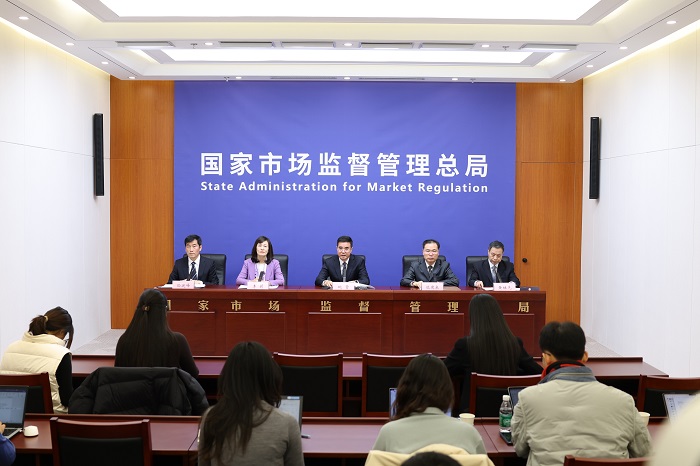
On December 10, 2025, an official press conference was held by the State Administration for Market Regulation (SAMR) on the policy document the Action Plan on the Improvement of Quality Certification Competence (2025-2030) (hereinafter referred to as “the Action Plan”), and several officials from other relevant regulators or entities also attended the press conference to provide further information on the Action Plan.
The Action Plan was originally issued to the public on the same date as the press conference, consisting of five chapters that put forward general requirements, purpose, main goals and eight key tasks. In China, quality certification is considered as significant tools for quality management, market credibility and trade facilitation, but the present system development level in China is viewed as insufficient on sector credibility, weak on support of high-quality economic development, and short of international influence (hereinafter referred to as “the three issues”). The Action Plan intends to mitigate the three issues.
Specific goals are laid out in the document in three stages:
- By the end of 2026, establish a comprehensive traceability system covering the entire life cycle of certification, featuring “searchable certification rules, traceable certification processes, and traceable certification results” to strengthen the responsibilities of certification bodies and personnel.
- By the end of 2028, make the certification system more closely aligned with demands, with certification results becoming more authoritative and reliable, and achieving new breakthroughs in the professional capacity development of the certification industry. Provide sufficient certification supply, while reducing homogeneous competition.
- By 2030, effectively address the three issues.
The eight key tasks outlined in the Action Plan mainly raise requirements for all relevant stakeholders in the quality certification supply chain from two perspectives:
- Consolidate compliance foundation to enhance credibility:
Certification bodies: strengthen corresponding responsibilities to ensure compliance with their certification results, operation and system management, necessary internal review and evaluation, certification process control, competence training, research activities, development of certification rules and personnel management mechanism.
Certification personnel: further reform the qualification review system for certification bodies to enable differentiated personnel competence requirements; strengthen accountability of certification personnel of their certification results; improve training and learning system; improve management requirements for personnel registration and carry out effective supervision.
- Improve professional competence in all elements of the industrial chain:
Certification bodies: intensify the capabilities on innovation, comprehensive service, branding and digitalization, such as: creating innovative certification system based on modern quality theories, facilitating the mutual recognition of certification results from up and down streams within the same industrial chain, actively participate in international cooperation to improve credibility and influence, and encouraging the integration and exploration of new certification models with modern information technologies (e.g.: AI, blockchain, big data etc.)
Certification personnel: consistently improve professional competence; create new knowledge system that shall meet the needs of innovative quality certifications; promote international mutual recognition of professional talents; establish cross-sector mechanism for certification experts; establish international talent training program to build a international talent and expert pool; effectively improve and achieve better training quality for talents.
Regulators and other stakeholders: SAMR will be the key stakeholder on the implementation and achievement of the tasks, while China National Accreditation Service for Conformity Assessment (CNAS) will support on optimization and strengthening of accreditation system, the Certification Research Center of SAMR will assist on advanced theoretical and technological research, and the China Certification & Accreditation Association (CCAA) will help on the personnel management affairs.
The Action Plan is one of the series moves of SAMR in recent years in the purpose of solving the three issues. There has been a total of 6 policy documents issued as of the date this article was drafted including the Action Plan, and the other five national documents are:
- Action Plan for Accelerating High-level Opening-up of Certification and Accreditation (2024-2030), issued in September of 2024.
- Action Plan for Strengthening Enterprises, Chains and Counties through Quality Certification Services (2024-2026), issued in September of 2024
- Action Plan for Building the Credibility of the Quality Certification Industry (2024-2026), issued in November of 2024.
- Action Plan for the Promotion and Popularization of Quality Certification, issued in November of 2024.
- Guiding Opinions on Accelerating the Digital Development of Quality Certification, issued in September of 2025.
Source:
- The original policy document: https://www.cnca.gov.cn/zwxx/tz/2025/art/2025/art_4f3ea873c1754c3ba9f5704b6775ddfa.html
- SAMR Conference: cnca.gov.cn/xwjj/scjgyw/art/2025/art_f1c4c41edcbe47f49d51e9705b0e2359.html