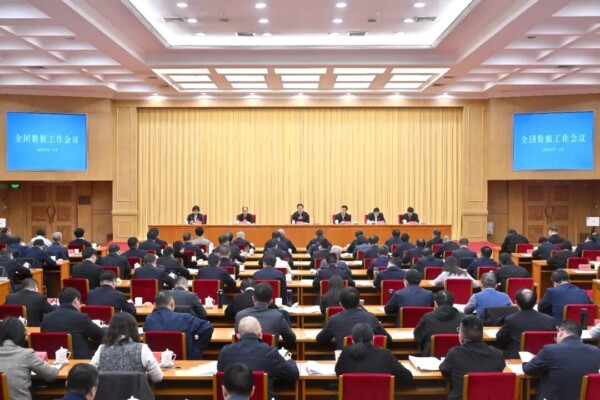
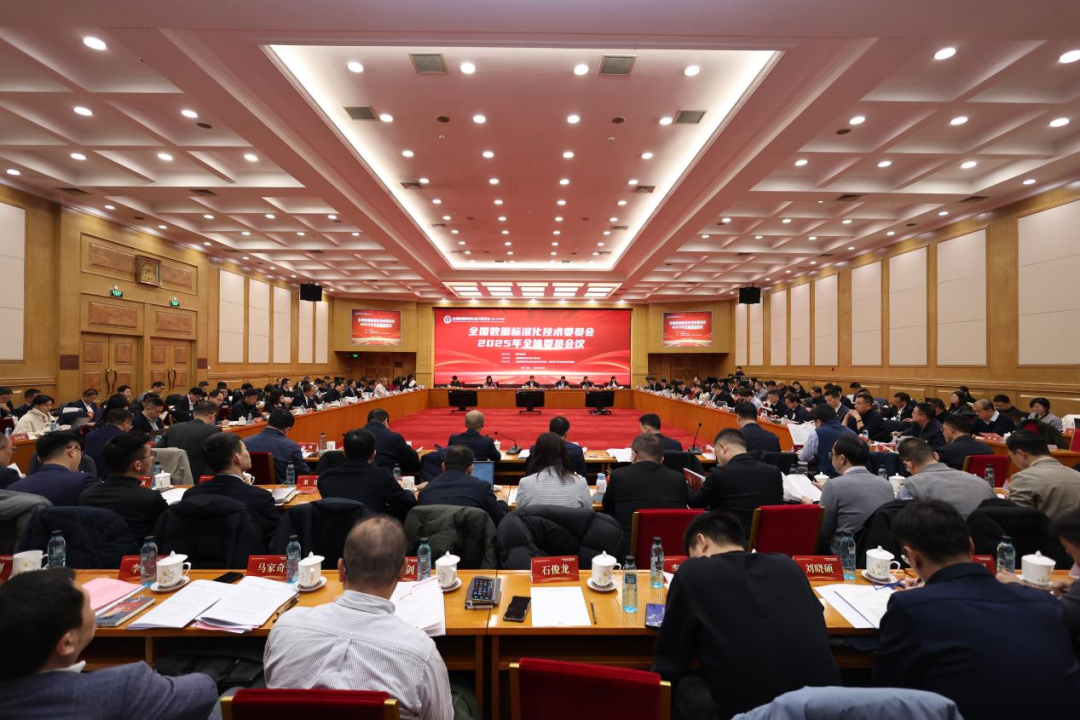
On January 5, 2026, the National Technical Committee on Data Standardization (SAC/TC609) convened its plenary meeting in Beijing. Mr. Liu Liehong, Chair of TC609 and Administrator of the National Data Administration (NDA), delivered a keynote address emphasizing the strategic role of standardization in releasing data value. Ms. Zhu Meina, Deputy Director-General of the Department of Technical Management at the State Administration for Market Regulation (SAMR), attended and provided remarks. The session was hosted by Mr. Xia Bing, Vice Chair of TC609 and Vice Administrator of the NDA. Participants reviewed past achievements and formally adopted the 2026 work priorities, establishing ambitious quantitative targets for the year ahead.
In 2025, the committee significantly expanded its ecosystem and enhanced output quality to support national data reforms. It successfully integrated over 1,550 members from government, industry, academia, and research sectors, creating a robust collaborative network. The organization of two “Standard Weeks” attracted more than 3,500 participants, substantially raising the profile of data standardization nationwide.
In terms of deliverables, the committee developed 48 national standards and technical documents, with over 1/3 undergoing simultaneous verification pilots to ensure practical applicability. This approach ensured a synchronous improvement in both the quality and quantity of standard supply.
Mechanisms were strengthened through coordination with multiple sector and local standardization committees, leading to the establishment of six specialized industry application groups covering natural resources, ecological environment, disease control, traditional Chinese medicine, media, and pharmaceuticals.
International cooperation achieved a major breakthrough as 4 Chinese experts secured key leadership roles in global organizations, and a memorandum of cooperation was signed with the International Data Spaces Association (IDSA).
The strategic focus for 2026 is unlocking data element value through aggressive standardization targets. The committee aims to develop no fewer than 80 national standards and technical documents, with at least 30 designated as key priority standards. This effort is designed to resolve the complex trade-offs between data security, efficient circulation, and privacy protection while boosting social awareness through revised guidelines and high-impact events. The execution framework comprises 5 dimensions:
- Improve the Data Standards System & Forward-Looking Research
- Accelerate standards formulation for key areas including data governance, circulation, comprehensive digital transformation, technology, and infrastructure to align industry’s understanding.
- Launch standards research for emerging fields, specifically embodied intelligence, agents for data infrastructure, and high-quality datasets.
- Formulate & Revise Basic and Generic, and Sector Standards
- Accelerate the formulation of basic data terminology standards to unify industry understanding of core concepts.
- Develop standards for data product description, quality evaluation, and data element talent metrics.
- Create “Important Data” identification catalogs for strategic industries such as automotive, industrial, telecommunications, seed, aerospace, geographic information, and civil aviation to support safe market construction.
- Establish standards for public data resource registration and authorized operation, including guidelines for utilization scenarios, trusted data space value assessment, and service catalogs.
- Define maturity models for smart city transformation, covering intelligent hubs, data ledgers, perception systems, and digital industry clusters.
- Standardize high-quality dataset lifecycles, including collection formats, annotation, anonymization, and interaction interfaces for AI training.
- Advance data infrastructure standards regarding reference architectures, interconnection, identity management, and national integrated computing power network scheduling and pricing.
- Launch sector-specific data fusion research for natural resources, ecological environment, disease control, traditional Chinese medicine, media (multimodal data), and pharmaceuticals (traceability and master data).
III. Promote Verification Pilots & Application Demonstrations
- Coordinate standard verification pilots and build a service system to create “standard sample rooms” for testing.
- Align standard formulation with industry needs by selecting typical application scenarios for pilot testing, linking results to annual performance assessments, and adapting standards to local practices.
- Cultivate a professional ecosystem of third-party data service institutions by evaluating capabilities in trusted data spaces, dataset quality, and urban digital transformation maturity.
- Deepen International Cooperation & Create Competitive Advantages
- Map out an international standardization roadmap and deploy Chinese experts to key duties and apply to host international standards meetings for ISO/IEC JTC1/SC32, ISO/IEC JTC1/WG11, ISO/IEC JTC1/SC42/WG2, and IEC/Syc Smart Cities. Closely track and actively participate in the work of ISO/IEC JTC4.
- Accelerate the submission of new international standard proposals for data models and smart cities, actively promoting the conversion of domestic standards into global norms.
- Deepen strategic exchanges with international organizations such as IDSA, CEN/CENELEC, ETSI, CATena-X, and Gaia-X through joint research and expert seminars.
- Optimize Committee Mechanism and Assurance
- Formulate the Administrative Measures for International Standardization Activities of the National Data Standardization Technical Committee.
- Convene plenary sessions, host nationwide “Standard Week” events, and host data standardization forums during major summits like the Digital China Summit and China International Big Data Industry Expo (also known as the Big Data Expo).
- Dynamically adjust working group membership and establish evaluation mechanisms for task forces to ensure high-quality output.
China’s 2026 standardization roadmap signals a decisive shift from theoretical framework construction to aggressive, granular implementation aimed at securing global market influence. The key observation is a coordinated dual-track approach.
Domestically, China is developing a comprehensive, vertically integrated framework that spans from “important data” definitions in strategic sectors like automotive and aerospace to technical specifications for computing power and AI datasets. This creates a detailed operational environment that stakeholders should monitor for potential alignment considerations with global norms.
Internationally, the focused effort to translate these domestic standards into ISO/IEC proposals and strengthen collaborations with organizations such as IDSA and Gaia-X reflects a clear intention to contribute Chinese perspectives to global data governance. European stakeholders may find it beneficial to proactively assess interoperability opportunities, particularly in data infrastructure and cross-border mechanisms, as China utilizes its extensive pilot programs to refine these standards prior to broader international engagement.
Source: https://www.tc609.org.cn/tc609/sjxw/202601/d184402c764e420b9aaf4d5d733b8184.shtml