On February 2, 2026, A coalition of ten Chinese government departments, including the State Administration for Market Regulation (SAMR) and the Office of the Central Air Traffic Management Commission, jointly released Guidelines for the Construction of a Low-Altitude Economy Standards System (2025 Edition) (hereinafter referred to as the Guideline). The Guideline aims to create a unified national approach to standardization, providing both foundational support and strategic direction for the high-quality development of the low-altitude economy, which transitions into rapid industrialization.
The Guideline sets a roadmap, outlining two key phases for the development of the standards system:
- By 2027: A basic standards system is expected to be in place to ensure safe and sound growth.
- By 2030: A well-structured, advanced, and internationally compatible system will be formalized, comprising over 300 standards.
The standards supply system is based on a “four-dimensional integration” where technical standards integrate with management rules, domestic standards with international rules, mandatory with voluntary standards, and foundational with scenario-specific standards. The Guidelines establish four core principles: safety as the foundation, strengthening top-level standards to address emerging risks; innovation-driven growth, integrating technological R&D, standard development, and industrial advancement while merging low-altitude aircraft with emerging technologies like AI and big data; industrial collaboration, building a cross-departmental and central-local collaborative system covering the entire value chain; and international alignment, leveraging technological advantages to position Chinese standards globally.
The framework targets standardization across five core sectors: Low-altitude aircraft standards provide technical and compliance guidelines for design, manufacturing, operation, and maintenance of aircrafts. Low-altitude infrastructure standards establish the foundational environment for safe and efficient low-altitude economic activities. Air traffic management standards enable efficient airspace use and orderly flight operations. Safety regulation standards underpin a comprehensive, multi-level supervision system. Application scenarios standards promote standardized adoption in sectors like agriculture and transportation, driving large-scale development. The structure of the low-altitude economy standards system is shown below.
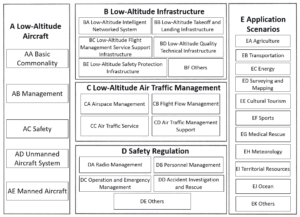
Figure 1. Structure of the low-altitude economy standards system
According to the Guidelines, the current low-altitude economy standards system table lists 313 standards, including released national and sector standards, standards under development, and proposed standards. Among them, there are 8 national mandatory standards, with 3 soon to be implemented, which are:
- GB46860-2025 Unique product identification code for civil unmanned aircraft (effective Jan 1, 2027)
- GB 46761-2025 Registration and activation requirements for civil unmanned aircraft (effective May 1, 2026)
- GB 46750-2025 Specification for civil unmanned aircraft system operational identification (effective May 1, 2026)
The release of the Guidelines signals a shift in China’s low‑altitude economy from a phase driven by policy incentives to one shaped by standardization. For domestic firms, the phased introduction of 313 standards will phase out unchecked expansion, channeling resources toward technologically capable players through mandatory national standards. For European companies, however, the challenge runs deeper than technical compliance. China’s emphasis on digital regulation and application‑driven scenarios differs from European risk‑based, privacy‑focused framework. Operating in China will therefore require European companies to adapt to a regulatory environment defined by data localization requirements, centralized rulemaking, and distinct compliance expectations.
Source: https://www.sac.gov.cn/xw/bzhdt/art/2026/art_63de05ceea7f426a9e7e20768975f5bb.html
https://www.gov.cn/zhengce/zhengceku/202602/content_7056835.htm