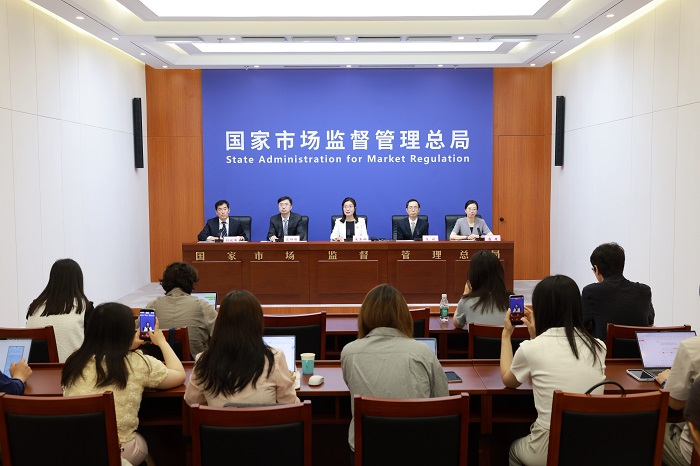
On 19 March 2026, the State Administration for Market Regulation of China (SAMR) released its legislative agenda for 2026 to enhance market system. The agenda comprises 18 distinct work items organized across 4 strategic priorities: market rules, e-commerce, quality infrastructure and safety bottom line for food, drugs, and other important industrial products. Particularly, three revision plans […]
On 31 March 2026, the National Standardization Administration of China (SAC) approved 23 mandatory national standards projects. Among these, 4 projects in the areas of electric vehicles(EV), intelligent and connected vehicles(ICV), vehicle data, and lithium-ion batteries are particularly noteworthy, as they will replace existing voluntary national standards(GB/T) with mandatory requirements(GB). Two of these standards – […]
On 23 March 2026, the Data Committee of the China Artificial Intelligence Industry Development Alliance (AIIA) held its first plenary meeting of the year in Beijing, bringing together over 150 representatives from academia, industry, and research institutions. The meeting reviewed progress in 2025 and outlined priorities for 2026. Wu Tongning, Deputy Director of the Artificial […]
On 2 April 2026, the Ministry of Science and Technology (MOST) and the Ministry of Industry and Information Technology (MIIT) jointly issued the Measures for the Administration of Artificial Intelligence Technology Ethics Review and Services(Trial) (hereafter “the measures”), with 8 other government departments (a full list of issuing authorities is annexed at the end of this article). MOST leads the overall coordination […]
On 28 February 2026, the State Administration for Market Regulation (SAMR) adopted the revised Measures for the Administration of Commodity Barcodes, replacing the 2005 version. The updated rules will enter into force on 1 May 2026. The revision reflects China’s broader policy objective of building a Unified National Market. It introduces a concept of centralized […]
On 28 February 2026, the Annual Conference on Standardization for Humanoid Robots and Embodied Intelligence (HEIS) was held in Beijing. The conference was hosted by the National Technical Committee on Humanoid Robots and Embodied Intelligence of the Ministry of Industry and Information Technology (MIIT/TC08) as its debut. During the event, the Standards System for Humanoid Robots […]
1. Introduction On March 13, 2026, Xinhua News Agency, authorized by the National People’s Congress (NPC) and the Chinese People’s Political Consultative Conference (CPPCC), released the Outline of the 15th Five-Year Plan (2026-2030) for National Economic and Social Development of the People’s Republic of China (hereafter referred to as the Outline), which serves as the […]
On 28 February 2026, the General Office of the State Administration for Market Regulation (SAMR) officially released the Key Points for National Metrology Work in 2026 to the public. The document, devised by the Metrology Department of SAMR, sets out a comprehensive roadmap to strengthen China’s national measurement infrastructure, with 53 key tasks focusing on 6 […]
On 27 February 2026, the National Standardization Administration of China (SAC) approved a batch of voluntary national standards including GB/T 47177.1-2026 Quantum computing service platform – Part 1: Architecture and functional requirements. This project was approved in December 2024 with a 12-month development timeline. China Academy of Information and Communication Technology (CAICT) led its drafting […]
The Seconded European Standardization Expert in China (SESEC) is a visibility project co-financed by the European Commission (EC), the European Free Trade Association (EFTA) secretariat and the three European Standardization Organizations (CEN, CENELEC and ETSI). One task of the SESEC project is to make the intelligence collection for China Standardization and Technical Regulation. Here we […]