On October 28, 2025, the Standing Committee of China’s 14th National People’s Congress passed a decision at its 18th Session to revise the country’s Cybersecurity Law, introducing significant updates aimed at addressing emerging technological challenges and reinforcing legal frameworks for data security and AI. The amendments, which will take effect on January 1, 2026, reflect China’s evolving approach […]

On October 23, 2025, China outlined comprehensive socio-economic targets for the “15th Five-year Plan” (2026-2030) as it would conclude the transformative “14th Five-year Plan” period (2021-2025). The new plan, set to guide national development through 2030, aims for the following goals: Notable advances in high-quality development Substantial progress in sci-tech self-reliance New breakthroughs in deepening reforms Marked […]
On 18 October 2025, the Technology Roadmap of Intelligent and Connected Vehicle Network (2025–2030) (hereinafter referred to as the roadmap) was officially released at the closing ceremony of the 2025 World Intelligent and Connected Vehicle Conference. The roadmap represents a collective achievement by the IMT-2020 (5G) Promotion Group C-V2X Task Group, the National Engineering Research Center of […]
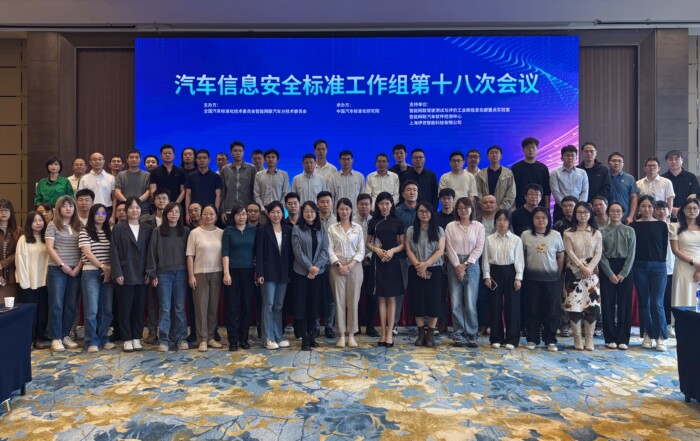
From 13 to 17 October 2025, the Subcommittee for Intelligent Connected Vehicles of the National Technical Committee of Auto Standardization (SAC/TC114/SC34) held the 18th meeting of the Automotive Information Security Standards Working Group and a series of standards seminars on intelligent connected vehicle. More than 200 experts from domestic and international vehicle manufacturers, component suppliers, […]
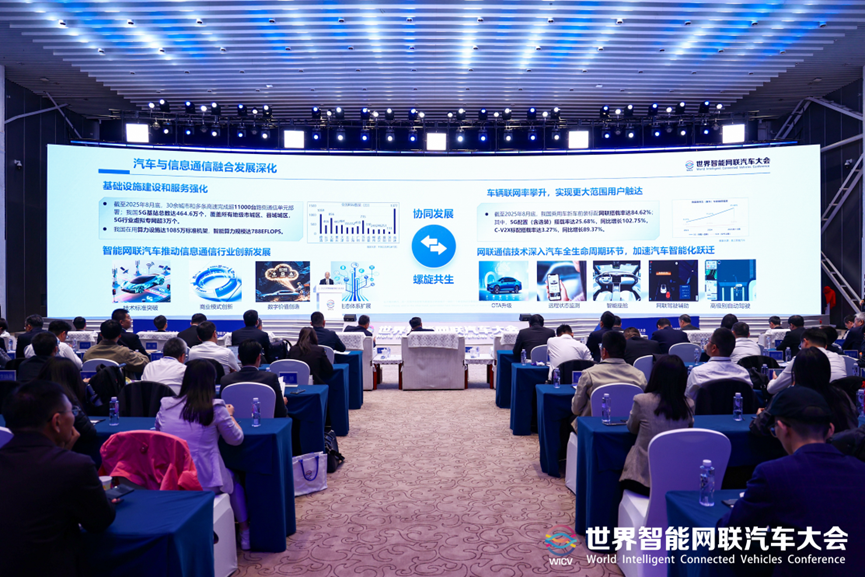
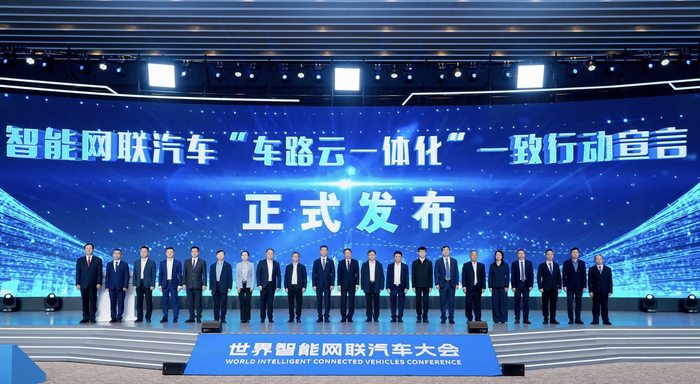
From 16 to 18 October, the 2025 World Intelligent Connected Vehicles Conference (WICV) opened in Beijing. Key attendees included Liu Wei, Minister at the Ministry of Transport (MOT); Xin Guobin, Vice Minister at the Ministry of Industry and Information Technology (MIIT); and Wan Gang, President of the China Association for Science and Technology. Other distinguished guests included Qi Yanjun, […]
On 27 August 2025, the national standard GB/T 37044-XXXX Cybersecurity Technology – Security Reference Model and General Requirements for the Internet of Things entered the call-for-comment stage. The standard falls under the responsibility of the National Technical Committee on Cybersecurity Standardization (TC260). The revision reflects China’s growing focus on the security implications of emerging technologies such as artificial intelligence, […]
On 16 October 2025, China National Institute of Standardization (CNIS) published the Standards Essential Patent Development Report (2025), a follow-up to its 2024 edition. The report highlights the growing convergence of standards and patents in China, extending beyond next-generation information technologies into emerging and future industries. It also notes that legislative, judicial, and enforcement activities concerning […]
On September 17, 2025, the BRICS Forum on Partnership on New Industrial Revolution 2025 – Sub-Forum on Digital Ecosystem, held recently in Xiamen, Fujian Province, gathered over 200 participants from China, Brazil, Russia, South Africa, Indonesia, Iran, Nigeria, and other BRICS and “BRICS+” nations. Guided by the Department of Information Technology Development under the Ministry of […]
On October 9, 2025, the Ministry of Industry and Information Technology (MIIT) and the National Standardization Administration (SAC) jointly issued the “Cloud Computing Comprehensive Standardization System Construction Guideline (2025 Edition)”. Compared to the 2015 version, the revised guideline features an optimized standards framework and layout, with enhanced focus on integrating cloud computing with AI and […]
From 25 September to 17 October 2025, the Ministry of Transport (MOT) launched a public consultation on the Draft for Comment for Standards System of Intelligent Transport System (2025) (hereinafter referred to as the “draft”). The draft focuses on practical applications and proposed updates to the existing standards system across three levels—general fundamentals, domain applications, and safeguards, […]