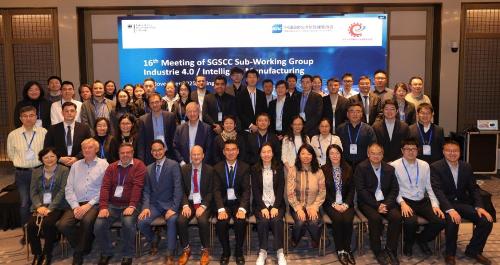
On 12 November 2025, the 16th Sino-German Intelligent Manufacturing / Industry 4.0 Standardization Working Group Meeting was successfully held in Qingdao, Shandong Province. Distinguished guests included Liu Dashan, Director of the Information Technology and Automation Standards Division under the Department of Standards and Technology Management, State Administration for Market Regulation (SAMR); Zhao Fengjie, Director of the Intelligent Manufacturing Division of the Equipment Industry Department I , the Ministry of Industry and Information Technology (MIIT); Boris Böhme, representative of the Industry 4.0 Digitalization Division at the German Federal Ministry for Economic Affairs and Energy (BMWE); and Marvin Böll, Head of SCI 4.0 at the German Association for Electrical, Electronic & Information Technologies (VDE/DKE). More than 80 representatives from the Sino-German Standardization Committees, enterprises, research institutes, and other organizations attended the meeting.
In the opening remarks, Liu Dashan stated that China and Germany should leverage standardization to strengthen foundation of industrial development, promote industrial optimization and upgrading, guide the rapid development of new business models and new forms of industry, and enhance the stability of industrial and supply chains, thereby continuously deepening bilateral cooperation.
In the German side’s opening speech, Boris Böhme noted that Sino-German cooperation has become an important driving force for global intelligent manufacturing standardization and expressed Germany’s willingness to continue expanding the dimension of cooperation.
Zhuo Lan, Director of the IoT Research Center of the China Electronics Standardization Institute (CESI), and Marvin Böll, Project Leader of SCI 4.0 at VDE/DKE, delivered joint remarks in their capacity as convenors of the technical task groups. They comprehensively introduced the achievements and future technical implementation directions of key standardization efforts under each task group, focusing on critical technologies such as network communications, information security, digital twins/asset administration shells, and artificial intelligence applications.
The task groups on artificial intelligence applications, automated manufacturing and product information, digital twins/asset management, and condition monitoring and predictive maintenance respectively reported their phased progress, providing technical support for subsequent standards development. Among them, Dieter Wegner, Vice President of DKE and Industry 4.0 Spokesperson of the German Electrical and Electronic Manufacturers’ Association (ZVEI), delivered a presentation themed on the Digital Product Passport 4.0, elaborating on its value in full life-cycle product management and putting forward proposals for Sino-German standard coordination. Li Ruiqi from CESI delivered a presentation on The Current Status and Development Trends of Standardization for Industrial Large Models Oriented to Intelligent Manufacturing, analyzing the key pathways for building an industrial large-model standard system and providing new directions for bilateral technical cooperation.
During the meeting, each technical task group collectively released multiple cooperation outcomes and provided key briefings. The Network Communications Task Group, jointly presented by Duan Shihui from the China Academy of Information and Communications Technology (CAICT) and Dr. Dominik Rohrmus from the (German) Labs Network Industrie 4.0 (LNI 4.0), released the Roadmap: Technical Expert Group Network Communication. The Information Security Task Group, jointly presented by Zhao Zitong from CESI and Dr. Karl Waedt from Framatome GmbH, released the Sino-German White Paper on Security Grading For Industrie 4.0 and Intelligent Manufacturing. The Functional Safety Task Group, presented by Xiong Wenze from the China Instrumentation Industry General Technical and Economic Research Institute and Peter Sieber from HIMA (Shanghai) Industrial Automation Co., Ltd., jointly released the White Paper on Digitalization of Functional Safety for Industrie 4.0 and Intelligent Manufacturing.
Finally, representatives from both China and Germany jointly summarized the outcomes of the meeting. Zhao Fengjie, Director on the Chinese side, expressed her hope that, on the basis of the solid cooperation established from the past, both sides will innovate communication mechanisms, identify needs from the diverse manufacturing scenarios in both countries, and promote the application and implementation of more new technologies and new standards.
Zhao Fengjie also emphasized the need to strengthen standards cooperation and actively contribute research outcomes to relevant international standardization organizations. The German representatives noted that, building on the reports released by the task groups, Germany will promote the practical implementation of Sino-German standards coordination, and looks forward to continued deepened cooperation with China in fields such as artificial intelligence and functional safety, while actively exploring new directions of cooperation in areas including industrial data and data spaces, as well as digital product passports.