
Chinese Standardization
Chinese Standardization
Current Standards System
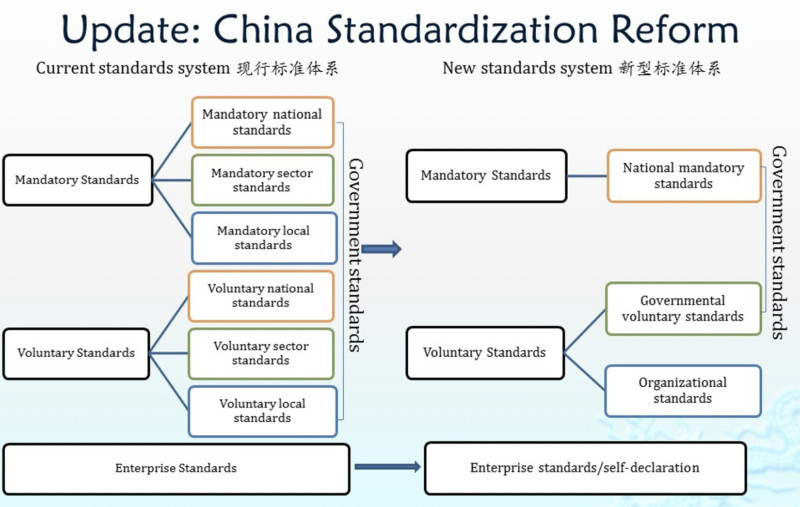
Mandatory National standards
Mandatory national standards shall be developed to address technical requirements for ensuring people’s health and the safety of their lives and property, safeguarding national and eco-environmental safety and security, and meeting the basic need of economic and social management.
Relevant administrative departments under the State Council shall, according to their duties and responsibilities, propose mandatory national standards and organize drafts, solicit opinions and conduct technical reviews thereof. The administrative department in charge of standardization under the State Council shall be responsible for proposal approval, the numbering and notification of mandatory national standards.
In current context, the “Relevant administrative departments under the State Council” means the ministries who wants to make mandatory standards (or simply regulators); while “The administrative department in charge of standardization under the State Council” is SAC.
Mandatory national standards are substantially equivalent to technical regulations in the sense of the WTO Agreement on Technical Barriers to Trade.
Recommended (Voluntary) national standards
Recommended national standards can be developed to address technical requirements that are needed to serve basic and generic purposes, support mandatory national standards or play a leading role in relevant industries.
The recommended national standards are developed by the administrative department for standardization under the State Council, i.e. SAC.
Sector (Ministry) standards
Where, in the absence of voluntary national standards, national unified technical requirements within a sector are needed, sector standards can be developed.
Sector standards are administrated by Relevant administrative departments under the State Council. In current context, the “Relevant administrative departments under the State Council” means the ministries who have the rights of making sector standards.
By now there are more than 60 categories of sector standards for different sector, such as YY/T for medical device, JB/T for machinery, QC/T for automobile, YD/T for communications, etc.
Local standards
Local standards can be developed to meet local natural conditions, customs and others.
Local standards are developed by the administrative departments for standardization of people’s governments of all provinces, autonomous regions and municipalities directly under the Central Government.
Association standards
Association standards were first introduced to China’s standardization system since the standardization reform.
According to the new standardization law of China, “The State encourages social organizations such as societies, associations, chambers of commerce, federations and industry technology alliances to coordinate relevant market entities to jointly develop group standards meeting the needs of market and innovation, which may be implemented by members of these organizations by agreement or be provided for other social members’ voluntary use in accordance with rules made by organizations in question.”
Association standards are developed by social organizations, but only “legally registered social organizations” can develop association standards. Under the current practice, the status of “legally registered social organizations” is strictly regulated by the Ministry of Civil Affairs (MCA).
By introducing Association standards, China is moving forward to establish and regulate a market-oriented system for social organization/association standards.
Enterprise standards
Enterprises may, where necessary, develop their own enterprise standards or work with other enterprises to develop enterprise standards.
The State supports the use of independent/indigenous innovative technologies to develop association standards and enterprise standards for important industries, strategic emerging industries, key generic technologies and other areas.
Standards self-declaration disclosure
China also introduced a self-declaration disclosure and supervision system with regards to association standards and enterprise standards. Enterprises shall disclose the number and name of the mandatory standards, voluntary standards, association standards or enterprise standards that they implement. Where enterprises implement enterprise standards they have developed themselves, they shall also disclose the functional indicators of products and services and the performance indicators of products. The State encourages the disclosure of association standards and enterprise standards to the public via public service platforms for standardization information.
Enterprises shall organize production and business activities in accordance with standards, and the products they make and the services they provide shall meet the technical requirements of the standards they have disclosed.
In summary, the number of the standards until end of 2019 were listed here.
| Standards in China | Amount |
|---|---|
| National – mandatory | 2111 |
| National – voluntary | 36877 |
| Sectoral standards | 62262 |
| Local standards | 37818 |
| Association standards | 9790 |
| Enterprise standards | 1140000 |
Table 1.the number of the standards until end of 2019
The standards drafted or revised in the year of 2019 were listed here. 1
| Item name | Achieved in 2019 | Details |
| National standards | 2021 | Published |
| New Standardization technical organizations | 41 | Concerning block-chain and other fields |
| Sector standards | 4880 | Put on record |
| Local standards | 7238 | |
| Association standards | 6227 | Issued |
| Enterprise standards | 370,000 | Published by 55962 enterprises through self-declaration |
| International standard projects | 238 | Proposed by China |
| new secretariats and leaderships in international standardization setting organizations (ISO/IEC/JTC1/ITU) | 8 | Proposed by China |
| Voluntary national standard projects | 2145 | With 52% elimination rate |
Table 2.Achievements of China Standardization in 2019
1 Data source: China 2019 Standardization Work Annual Meeting on January 19, 2020