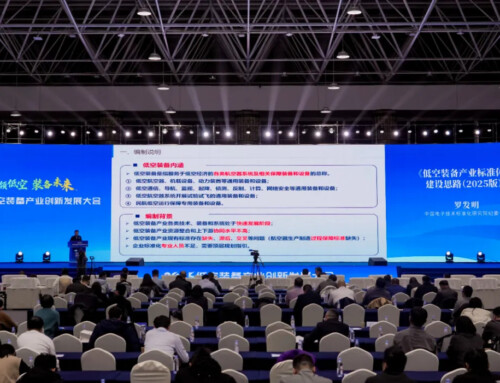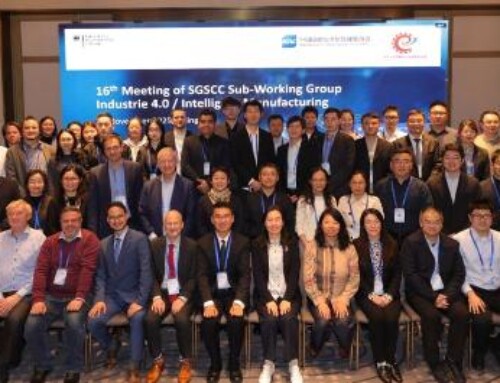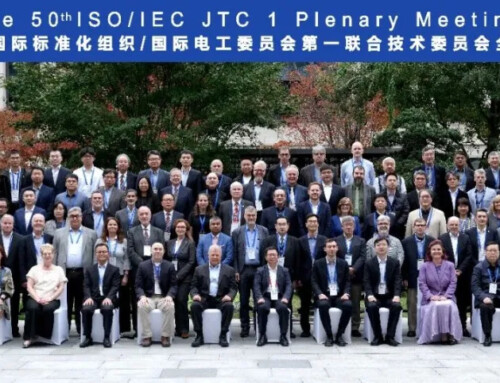

On 3 November 2025, the National Data Standardization Technical Committee (TC609) held its second “Standards Week” event of 2025.
- Distinguished Guests and Attendees
Mr. Liu Liehong, Administrator of the National Data Administration, attended the plenary meeting and delivered remarks. Mr. Wang Yuhuan, Deputy Director-General of the Department of Standards Technology and Management of the National Standardization Administration (SAC), also delivered speeches. Mr. Xia Bing, Vice Administrator of the National Data Administration, and Mr. Liu Xiangang, Vice President of the China Electronics Standardization Institute (CESI), presided over the meeting.
Representatives from the following 12 governmental institutions attended the event:
- Cyberspace Administration of China(CAC),
- National Development and Reform Commission(NDRC),
- Ministry of Public Security(MPS),
- Ministry of Agriculture and Rural Affairs(MARA),
- Ministry of Commerce(MoC),
- Ministry of Emergency Management(MEM),
- People’s Bank of China,
- State Administration for Market Regulation(SAMR),
- National Administration of Cryptography(NAC),
- National Energy Administration(NEA),
- National Railway Administration(NRA),
- National Disease Prevention and Control Administration(NDPCA).
Members of TC609, experts from relevant industries, representatives of standardization organizations, and officials from the national data system also participated in the event.
- Keynote Speech
Mr. Liu Liehong noted that since the establishment of TC609, China’s data standardization system has continued to improve, the development of data standards has accelerated, the scope of pilot verification has expanded, and international cooperation on data-related standards has deepened. All of these are aligned with the central task of advancing the market-oriented allocation reform of data as a production factor.
Data issued by the National Data Administration and the State Administration for Market Regulation, revealed that China developed and released more than 120 national standards in the data field during the 14th Five-Year Plan. These national standards have been applied in key areas such as artificial intelligence applications, new infrastructure, and data trading and circulation, supporting the high-quality development of the digital economy.
Mr. Liu emphasized, moving forward, TC609 should work on four priorities:
- Improving multi-level mechanisms for data standardization, promoting an effective model where unified national rules are supplemented by industry-specific and local characteristics.
- Optimizing data standards supply through diverse channels, with priority support for innovation-driven private enterprises with strong R&D capacities and core technologies to take the lead in standards development, transforming advanced business practices and industrial experience into national standards.
- Strengthening multi-dimensional verification and implementation of data standards, cultivating third-party evaluation service providers and making full use of testing, inspection, and certification mechanisms.
- Deepening international cooperation on data standards from multiple angles, enhancing talent development in international standardization and continually advancing the transformation of domestic technical standards into international standards.
Additionally, keynote speeches were delivered by Mr. Chen Jun, Director of the Moganshan Geospatial Information Laboratory and Professor at the National Geomatics Center of China; Mr. Yu Haibin, Researcher at the Shenyang Institute of Automation at Chinese Academy of Sciences; Mr. Ye Zhenzhen, Chairwoman of People’s Daily and Director of the State Key Laboratory of Communication Content Cognition; Mr. Sun Baolin, Director of the China Copyright Protection Center; Jarosław Kowalski, Chief Expert of CEN/CENELEC JTC 25; and Raymond Forbes, Vice Chairman of ETSI TC DATA.
- New Working Groups
TC609 officially established six industry application groups covering natural resources, ecological environment, traditional Chinese medicine, media, disease control, and pharmaceuticals to further strengthen coordination between national and sectoral data standardization efforts.
- Standards Discussion
From 4 to 7 November, the various working groups conducted intensive discussions on 72 standards and 27 technical documents over a four-day period.
- TC609 2025 Standardization Achievements
TC609 was established in October 2024 with the approval of the Standardization Administration of China (SAC). It has since received guidance from the National Data Administration. Over the past year, TC609 has actively implemented the requirements set out in the National Data Standards System Construction Guidelines. Its standardization work has been carried out across eight key areas:
- To strengthen data foundation, TC609 is developing 1 national standards
- 20255407-T-907 Data –Basic terminology
- To enhance data governance, TC609 is developing 2 national standards:
- 20255404-T-907 Data product – General requirements for quality evaluation
- 20255403-T-907 Data product – Description requirement
- To promote the circulation and utilization of data, TC609 is developing 2 national standards:
- 20255412-T-907 Data product –General requirements for quality evaluation
- 20255401-T-907 Authorized operation of public data resources—Guidelines for monitoring and evaluation
- To empower full-domain digital transformation, TC609 is developing 2 national standards:
- 20213294-T-469 Citywide digital transformation—Maturity model
- 20240865-T-469Citywide digital transformation – City intelligent center – Ability evaluation
And revising 3 national standards:
- 20250390-T-469 Citywide digital transformation–Terminology
- 20250317-T-469 Citywide digital transformation –Technical Reference Model
- 20255953-T-907 Citywide digital transformation—A model for assessing the level of effective data use in cities
- To enhance data technology capabilities, TC609 has published4 technical documents:
- TC609-5-2025-01 High-quality dataset –Construction guidelines
- TC609-5-2025-02 High-quality dataset –Format requirements
- TC609-5-2025-03 High-quality dataset –Classification guidelines
- TC609-5-2025-04 High-quality dataset –Specification for quality evaluation and test
Developing 8 national standards:
- High-quality dataset –Format requirements
- High-quality dataset –Classification guidelines
- High-quality dataset –Specification for quality evaluation and test
- High-quality dataset –Requirements for data annotation
- 20255955-T-907 Data service capability evaluation –Part 2: Evaluation elements
- 20255956-T-907 Data service capability evaluation –Part 3: Implementation guides
- 20255958-T-907 Technical requirements for data utilization management
- 20255957-T-907 Guidelines for the implementation and evaluation of data anonymization circulation
- To build a solid foundation of data infrastructure, TC609 has published 9 technical documents on data infrastructure:
- NDI-TR-2025-01 Data infrastructure – Reference architecture
- NDI-TR-2025-02 Data infrastructure – Connection requirements
- NDI-TR-2025-03 Data infrastructure – Digital identity management and access requirements
- Data infrastructure – Identification requirements
- NDI-TR-2025-05 Data infrastructure – Technical requirements for connectors
- NDI-TR-2025-06 Data infrastructure – Data catalog description requirements
- TC609-6-2025-11 Data infrastructure – Technical requirements for regional/sectoral functional nodes
- TC609-6-2025-12 Data infrastructure – Access management
- TC609-6-2025-13 Data infrastructure – General requirements for security capability
Published 4 technical documents on trustworthy data space:
- TC609-6-2025-01 Trustworthy data space – Technology architecture
- TC609-6-2025-14 Trustworthy data space – Technical requirements for digital contract
- TC609-6-2025-15 Trustworthy data space – Technical requirements for usage control
- TC609-6-2025-16 Trustworthy data space – Specification for technical capability evaluation
Published 9 technical documents on national integrated computing power network:
- TC609-6-2025-02 National integrated computing power network – Technical requirements for computing network connection of computing resources
- TC609-6-2025-03 National integrated computing power network – Technical requirements for computing power and efficiency measurement
- TC609-6-2025-04 National integrated computing power network – Technical specification for pooling of computing resource in artificial intelligence data center
- TC609-6-2025-05 National integrated computing power network – Technical specification for management and scheduling of computing resources
- TC609-6-2025-06 National integrated computing power network – Technical requirements for computing measurement and billing
- TC609-6-2025-07 National integrated computing power network –Technical Requirements of Computility Operation Service and Matching Transaction
- TC609-6-2025-08 National integrated computing power network – Technical requirements for network connection of computing power resources
- TC609-6-2025-09 National integrated computing power network – Requirements for capability assessment of computing centers
- TC609-6-2025-010 National integrated computing power network – Security protection requirements
Converting 6 technical documents on data infrastructure to national standards:
- 20255402-T-907 Data infrastructure—Technical requirements for connectors
- 20255405-T-907 Data infrastructure—Connection requirements
- 20255406-T-907 Data infrastructure—Digital identity management and access requirements
- 20255408-T-907 Data infrastructure—Reference architecture
- 20255409-T-907 Data infrastructure—Identification requirements
- 20255410-T-907 Data infrastructure—Data catalog description requirements
And developing another 2 national standards on national integrated computing power network:
- National integrated computing power network– Basic requirements for the network transmission service capacity of the public transmission channel
- National integrated computing power network– Guidelines for monitoring and scheduling platform
- To strengthen forward-looking planning, TC609 has published two reports:
- Research Report on Standardization of Trustworthy Data Space (2025)
- Research Report on Standardization of Media Data (2025)
- To deepen international cooperation in the data field, 4 international standards on data quality and smart cities led by TC609 experts have been published:
- ISO/IEC 5259-4:2024 Artificial intelligence – Data quality for analytics and machine learning (ML) Part 4: Data quality process framework
- ISO/IEC 11179-34:2024 Information technology – Metadata registries (MDR) – Part 34: Metamodel for computable data registration
- ISO/IEC 5394:2024 Information technology – Criteria for concept systems
- ISO/IEC TR 25005-2:2025 Information technology – Data use in smart cities – Part 2: Use case analysis and common considerations
And submitted 7 international standards proposals that are under drafting:
- ISO/IEC AWI 24927 Information technology – Data usage – Evaluation of data usage in organizations
- ISO/IEC PWI 26029 Information technology – Data management maturity model
- ISO/IEC AWI 25623 Artificial intelligence – Machine Learning(ML) model description framework
- ISO/IEC DIS 25005-1 Information technology – Data usage in smart cities – Part 1:
- ISO/IEC CS TS 25005-3.2 Information technology – Data usage in smart cities – Part 3: Measurement, evaluation and reporting
- ISO/IEC WD 5087-4 Information technology – City data model – Part 4: Service level concepts for public health emergencies
- ISO/IEC CD 21252 Information technology – Guidance on smart city ICT infrastructure planning – Overview
On top of that, TC609 experts have successfully undertaken convenor roles of ISO/IEC JTC1/SC42 WG2 Data and maintained collaborative relationships with CEN-CENELEC JTC25, International Data Space Association (IDSA), GAIA-X, Catena-X and ETSI TC DATA.
- Next Steps
TC 609 will continue to advance data standardization in line with the key priorities of the 15th Five-Year Plan. The Secretariat will soon launch the call for comment and review process for the national standard 20255407-T-907 Data – Basic terminology.
Next, TC609 will speed up the development of technical documents and the Research Report on Data Standardization for the Low-Altitude Economy, move them into the call for comment stage, and carry out pilot testing to ensure the technical content is practical and reliable. More organizations will be invited to participate in drafting work.
Last but not least, all working groups will follow action plans set during the standards week, strengthen cooperation and resource sharing, accelerate the development of international standard proposals, and further increase China’s participation and contribution to international standardization.
Source: https://www.tc609.org.cn/tc609/sjxw/202511/56e9b2f7058c44b6a2fe0bd62564bdb7.shtml