

On November 24, 2025, the 2025 RISC-V Industry Development Conference and RDSA International Summit (hereafter referred to as the Conference) was held in Zhuhai, Guangdong, drawing nearly a thousand scientists, academicians, and industry leaders from across the world. The Conference was jointly hosted by institutions such as the RISC-V Ecosystem and Industry Committee under China Electronics Standardization Association (CESA) and RDSA Industry Alliance. Under the theme “Building Standards Together, Connecting Ecosystems,” the Conference served as a pivotal platform for in-depth discussions on technological breakthroughs, ecosystem collaboration, and application deployment for RISC-V.
In his opening address, Mr. Xiong Jijun, Vice Minister of the Ministry of Industry and Information Technology (MIIT), highlighted RISC-V as a key pathway for China to achieve high-level self-reliance in critical areas like AI chips and high-performance processors. He stressed its strategic role in strengthening China’s digital economy foundation and enhancing global competitiveness. Mr. Xiong added that MIIT will step up top-level planning and policy support to drive breakthroughs in RISC-V standardization, R&D, application, and global collaboration—fostering an independent open-source ecosystem and injecting new momentum into worldwide computing innovation.
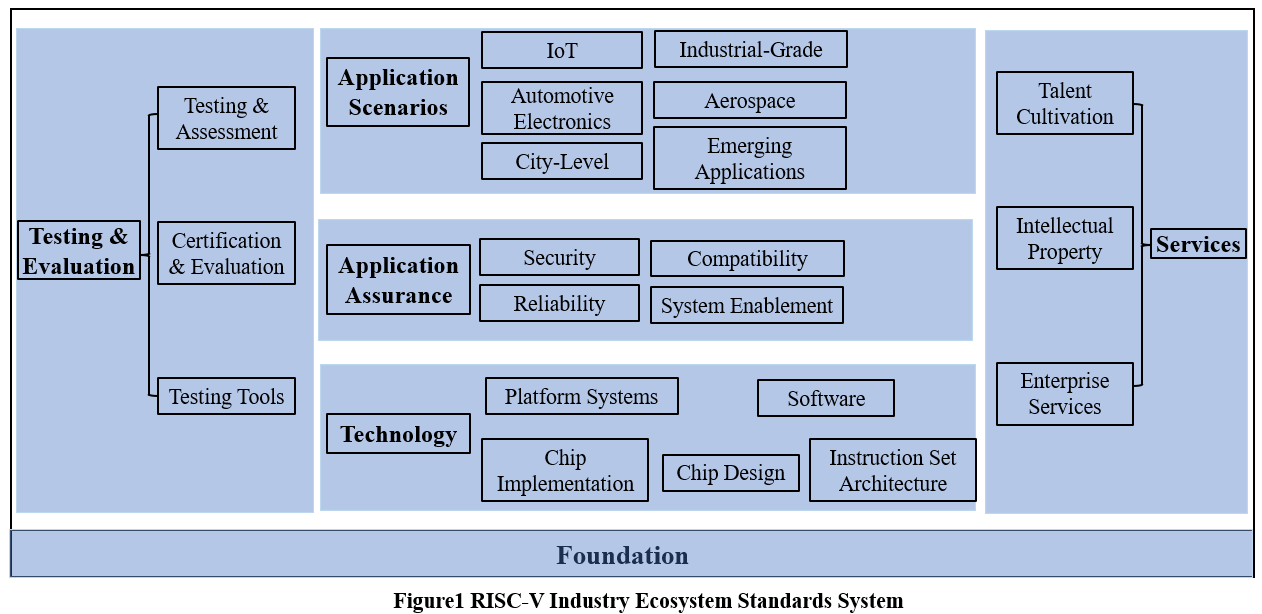
A landmark achievement of the Conference was the official release of the RISC-V Industrial Ecosystem Standards System (See the Figure 1), a collaborative effort by key institutions including the China Electronics Standardization Institute (CESI) and China Industrial Control Systems Cyber Emergency Response Team (CIC-CERT). Signifying a major step in global collaboration, Mr. Zhang Hongtu, Chairman of CESA, signed a Memorandum of Cooperation with the Brazil Semiconductor Industry Association. This pact aims to build a vital bridge for interconnecting open-source ecosystems worldwide.
The momentum continued on November 25 with the Global Cooperation Special Forum (Macau), where discussions centered on “International Cooperation and Talent Cultivation,” and new opportunities of global cooperation in the RISC-V sector. A significant highlight was the inauguration of the Greater Bay Area RISC-V Ecological Development Center’s DSA Development Laboratory in Macau, which marks a new phase of synergistic collaboration between Zhuhai and Macau in technology R&D and resource sharing. The successful conclusion of the Conference not only showcased China’s remarkable progress in the RISC-V domain but also stood as a significant milestone for global collaborative development within the open-source chip ecosystem.
In conclusion, the Conference signifies a pivotal acceleration in China’s systemic and standardized development of the RISC-V ecosystem. For foreign stakeholders, it offers clearer pathways for collaboration and market integration, particularly within standard-setting processes. Conversely, the maturation of a China-led ecosystem will amplify competitive pressures across technology architecture, talent acquisition, and market dynamics.
Chinese source of the article: https://www.cesa.cn/detail?paId=234&nbId=1038