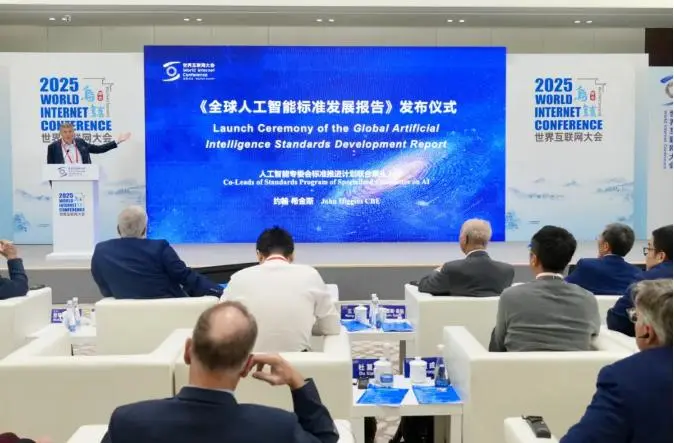
On 9 November 2025, the Global Artificial Intelligence Standards Development Report (hereinafter referred to as “the Report”) was officially released at the 2025 World Internet Conference Wuzhen Summit.
Under the umbrella of Standards Promotion Initiative established by the AI committee under the World Internet Conference, this report was an outcome of a collaborative effort between the China Academy of Information and Communication Technology (CAICT) and International AI Governance Association (IAGA). President of IAGA, John Higgins, presented the main findings and forward-looking recommendations of this joint research effort.
Grounded in a comprehensive view of global AI standardization, the Report systematically analyzes the current state and emerging trends in the development of global AI standards, examines key obstacles and challenges, and proposes concrete recommendations for advancing responsible AI standards.
The Report emphasizes that global cooperation is essential to building an inclusive, interconnected, and sustainable AI standards system. To achieve this goal, international organizations, governments, industry stakeholders, and research institutions must work together, jointly address challenges, and continuously promote the formulation and implementation of responsible AI standards.
The Report identifies four major challenges currently facing global AI standards development:
(1) Acceleration of technological iteration occurs simultaneously with widening gap in standards development.
- Increasing complexity across industrial chains heightens the difficulty of standard formulation.
- Divergence in governance concepts raises the threshold for achieving consensus; and
- Practical disparities among Global South countries limit their participation in standards initiatives.
To address these issues, the Report stresses that advancing global AI standards is not a task any single actor can accomplish alone, but rather a systematic project requiring global collaboration. It outlines four key directions:
- International organizations should coordinate with each other and together build a solid foundation for AI standards development.
- Government agencies should strengthen overall planning to improve interoperability and mutual recognition of standards.
- Industry should concentrate on technology and collaboration to accelerate the adoption and translation of standards; and
- Research institutions should deepen fundamental research to support frontier exploration and talent development.
Promoting global AI standardization has become a crucial task for supporting the sound development of AI technologies and strengthening safety governance frameworks. As a milestone achievement in this field, the Global Artificial Intelligence Standards Development Report provides the international community with a systematic reference for understanding the current landscape and future trajectory of AI standardization, and offers valuable insights for industry, academia, and policymakers seeking to engage in collaborative efforts.
The release of the Report is expected to further the dissemination and implementation of responsible AI principles and contribute to building a more open, inclusive, and sustainable global AI standards ecosystem.
The Report was published in Chinese language at the 2025 World Internet Conference.
For readers who are keen to get a copy, click here to download: World Internet Conference – Global AI standards development report – Chinese