
On 28 November 2025, the 2025 Low-Altitude Equipment Industry Innovation and Development Conference was held in Ordos, Inner Mongolia. At the main forum of the conference, the China Electronics Standardization Institute (CESI) officially released the Development Framework for the Standard System of the Low-Altitude Equipment Industry (2025) (hereinafter referred to as the “Standard System Framework”).
During the release session, Luo Faming, Secretary of the Commission for Discipline Inspection of CESI, pointed out that China’s low-altitude equipment industry is currently developing rapidly; however, the development of standards for low-altitude equipment has lagged behind. There is still a lack of coordinated and unified top-level design for the standard system.
As the secretariat unit of the Standardization Working Committee for the Low-Altitude Equipment Industry, CESI, together with 39 industry, academia, research, and application-oriented organizations—including the Equipment Industry Development Center of the Ministry of Industry and Information Technology, the China Aeronautical Radio Electronics Research Institute, and the China Academy of Civil Aviation Science and Technology—jointly compiled the Standard System Framework, providing systematic guidance to promote the high-quality development of standardization work for the low-altitude equipment industry.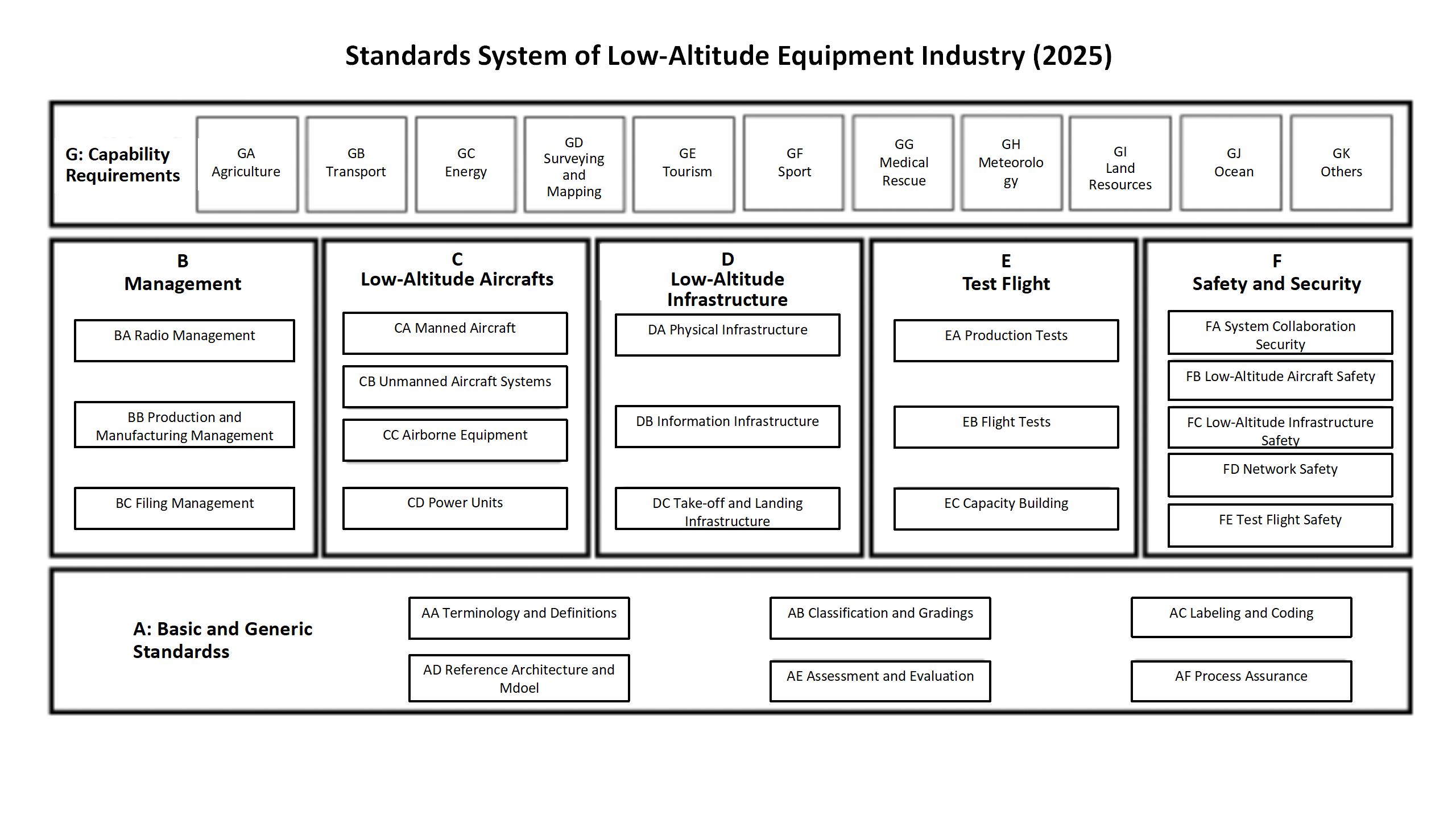
Figure from Development Framework for the Standard System of the Low-Altitude Equipment Industry (2025), unofficially translated by SESEC.
The Standard System Framework proposes a standards system architecture for the low-altitude equipment industry consisting of three major levels and seven components. It is supported at the foundation by basic and generic standards, takes management, technology, and safety standards as the core content, and applies capability requirement standards as the means of implementation. It comprehensively covers all stages of low-altitude equipment, including research and design, engineering and manufacturing, testing and flight trials, operation and maintenance support, and personnel training.
Moving forward, the Standardization Working Committee will continue to improve the top-level design of standardization work for the low-altitude equipment industry, identify urgent standardization needs of the industry, and use high-quality standardization to support the development of the low-altitude equipment industrial system, thereby promoting the safe, digitalized, intelligent, and cluster-based development of the low-altitude equipment industry.
Download the document here for reference: 低空装备产业标准体系建设思路(2025版)