On July 2, 2024, the Ministry of Industry and Information Technology (MIIT), the Office of the Central Cyberspace Affairs Commission (CAC), and the Standardization Administration of China jointly issued the Guidelines for the Construction of the National Artificial Intelligence Industry Comprehensive Standardization System (2024 Edition), (hereinafter referred to as the Guidelines). The Guidelines represent an overhaul of the previous version issued in 2020, to respond to new standardization needs and demands. Presently, new technologies based on large models continue to iterate, and artificial intelligence has found wider application in all aspects of our lives. Statistics show that China has established more than 400 national intelligent manufacturing demonstration plants, and more than 4,500 artificial intelligence enterprises.
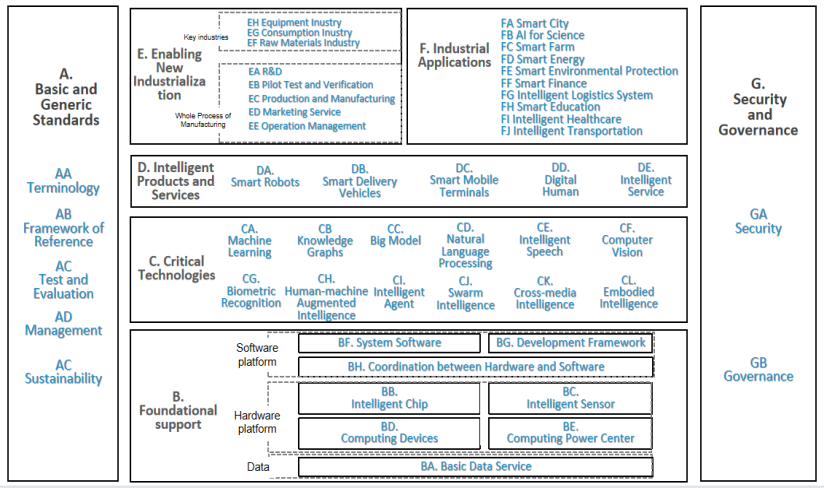
The goal of the Guidelines is to build a standardized system covering the whole life cycle of the artificial intelligence industry, addressing seven main aspects: basics and generics, foundational support, critical technologies, intelligent products and services, enabling new industrialization, industrial applications, and security governance (see Figure 1). Among these, foundational support includes specifications on data, computing power, algorithms, etc.; critical technologies part entails requirements for technologies used to process text, speech, and images. Additionally, compared with the previously released draft for comments, the final version of the Guidelines has introduced a new part in the standard system called “enabling new industrialization”, which aims to standardize the technical requirements of AI technology that enables the intelligent manufacturing and intelligent upgrading of key industries.
The Guidelines also set a series of targets to reach by 2026:
- Over 50 new national standards and sector standards formulated;
- Over1,000 enterprises participating in official standard publicity and promotion sessions (usually organized by governmental authorities and/or relevant institutions);
- Engagement in the development of more than 20 international standards.
In addition to the release of the Guidelines, MIIT also published the plan for establishing the sectoral standardization technical committees of artificial intelligence, which will be responsible for formulating sectoral standards, with the secretariat hosted in the China Academy of Information and Communications Technology. Beyond the field of AI, MIIT also took actions in other emerging industries, such as setting sectoral technical committees for brain-machine interface and releasing two mandatory national standards for intelligent and connected vehicles, namely: Basic security requirements of spatio-temporal data sensing system of intelligent and connected vehicle, and Basic requirements of security processing for intelligent and connected vehicle spatio-temporal data.
Figure 1: China’s AI Standard System